
 Posted by
 Last week, I dropped a post that went over how Facebook classifies a political ad and how research these ads in three different ways using three different tools. One of these was ProPublica’s Political Ad Collector which can be used to gain insight into why you see the ads that you see on your Facebook profile.
But while we went over how you can use the tool for a preliminary investigation of what kinds of ads you do or do not see on your Facebook feed (see also previous post for more on filter bubbles and personalization), or what information is used by third parties such as advertisers to identify you as a target audience, we didn’t have time to ask a broader question: are there any key partisan differences between results?
Or, to put it more academically: what unscientific conclusions might we get from dicking around on the tool pretending to be other people just for the lols?
Just for fun, let’s play around and see what different results are yielded for different people. First I’m going to type in the demographics of a hypothetical extended relative. Then I am going to type in my own, to see what trends emerge. If you need to refresh your memory on Facebook’s advertisement standards or scroll down to the “Political Ad Collector” section for the briefest of overviews here. I mean, you can review how to use the Political Ad Collector at the same link, but honestly now that I’m done pimping it you can probably get the drift.
Let’s start with my Hypotethical Relative demographics.
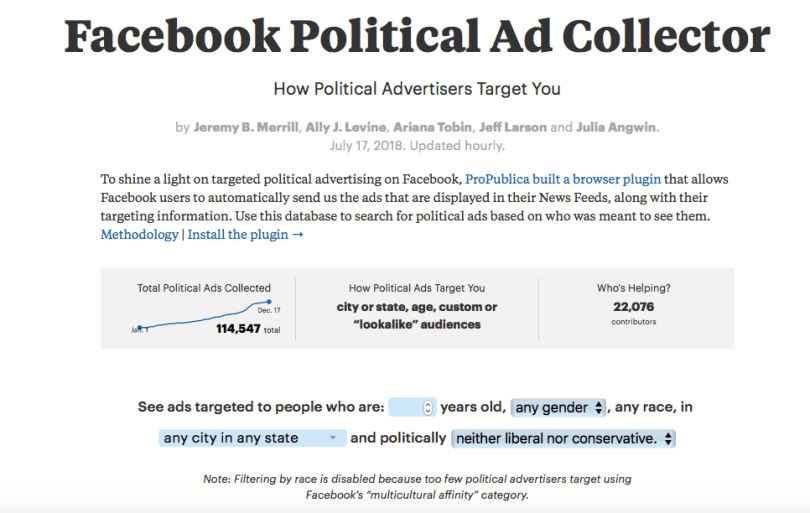
Hypothetical “Extended Relative” Demographics:
When I type in these demographics

This is the initial results interface.
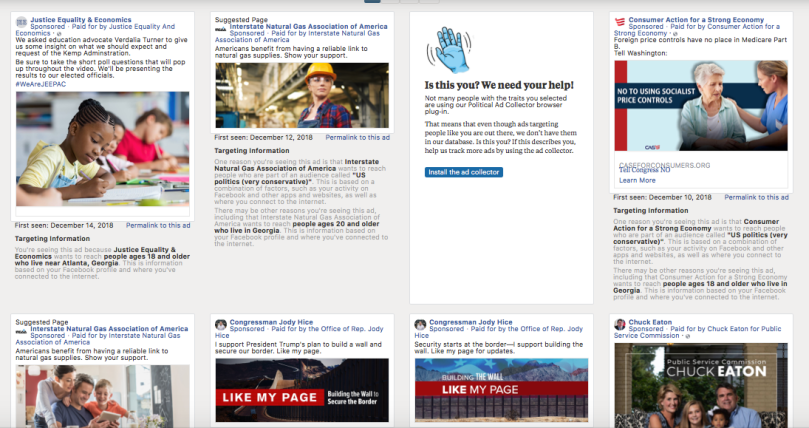

Close up on two sample ads on the page that are not advocating a particular candidate:
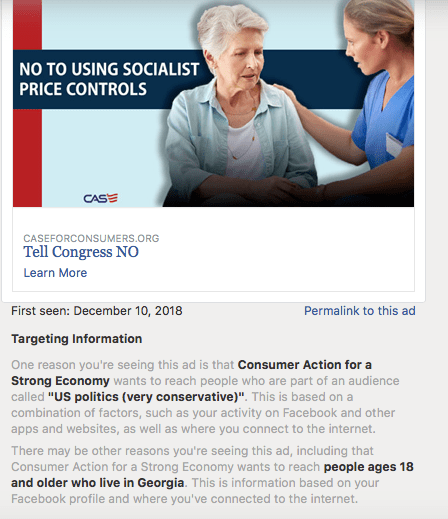
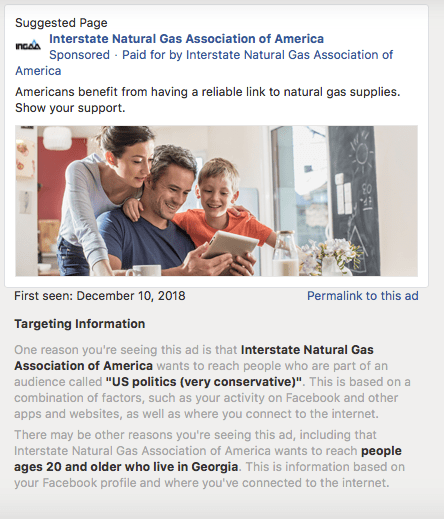
The first thing that I noticed the first time I did this experiment is that every Targeting Information block on the page contained this line: “one reason that you are seeing this ad is that [Source] wants reach people who are part of an audience called “US politics (very conservative).” After having done this search multiple times in writing/screencaping for this post, the first ad on top page (far left corner) no longer appears. In fact, clicking on the ad lead to me a Facebook page of what seems to be a liberal leaning organization that, amongst other things, encourages small businesses — something that could be a potential compromise between southern conservatives and decentralization liberals.
Although I selected “78” for age, the ads were most directed at users 18 and up instead of “60 and up.” I suspect my own browsing history in and outside of Facebook may factor into this calculation.
As you can see on the first screenshot of the page, the Ad Archive Collector greeted me with a message:
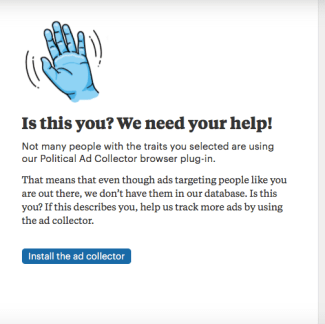
Because most of Political Ad Collector’s information comes from its 22, 076 participants who have installed its plug-in to spend in ads they encounter, it is important for them to get as a broad a user base as possible. This greeting openly admits that not many 78 year old conservatives from Georgia use their site. This is not unexpected, given how media ecologies tend to distribute information not into a divided “Democratic sphere” vs. a “Republican sphere,” but in a divide between “the far-right sphere” and “the everybody else web” (Anonymous, “Sorry to Burst Your Bubble“).
My Demographics:
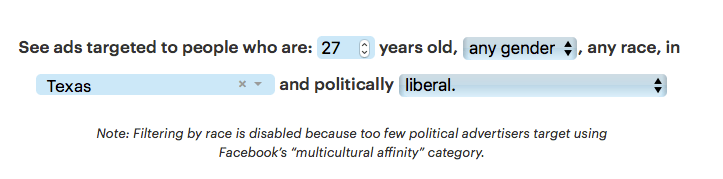
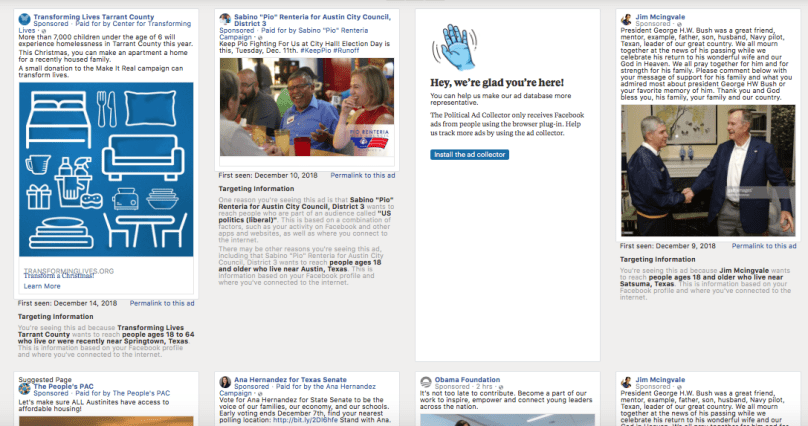
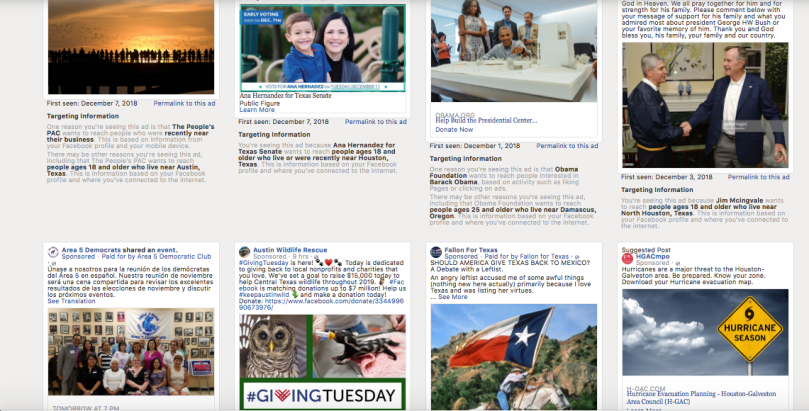

It’s hard to tell in these screenshots because I had to Zoom Out so far to visualize this interface, but my results were much less ideologically cohesive than my imaginary 78 year old. The first time I did this experiment with my real demographics, I only had a few ads that explicitly pushed for a candidate in a race. In the Georgia experiment, I immediately confronted a deluge of campaign ads for ilk I won’t advertise by mention. In general, the ads directed at the Georgia conservative almost always listed “very conservative” as an attribute of their targeted audience. The first few times I did the second experiment, very few (if any) ads listened “liberal” or “very liberal” as a target.
When I went back to ads before or after the 2018 midterms, I did get many more ads for political candidates and ballot initiatives. These did explicitly aim at a “very liberal” audience, particularly, on political candidates.

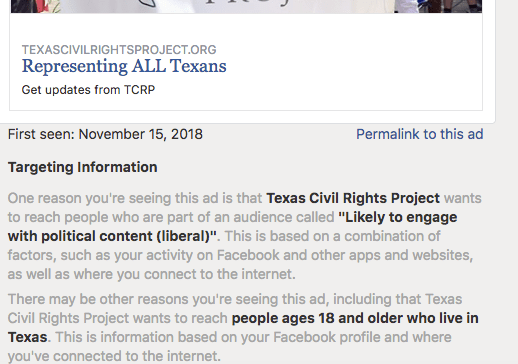
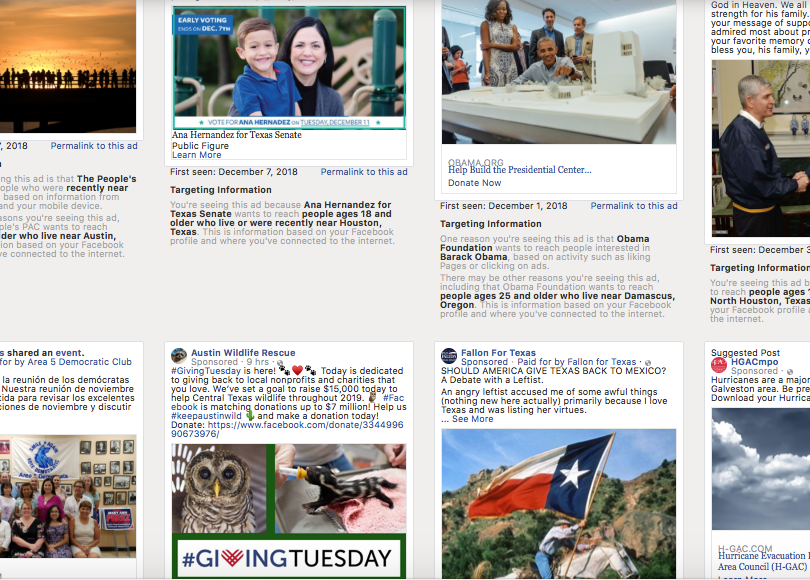
I also encountered quite a few ads that were not explicitly partisan.
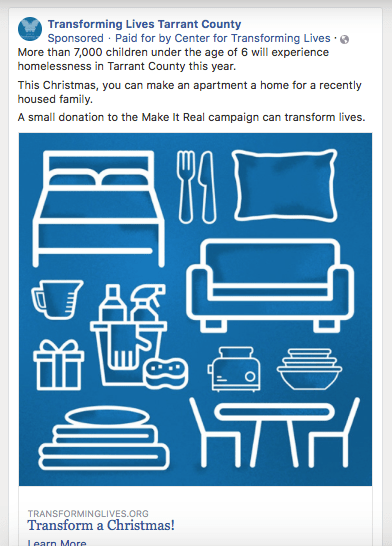
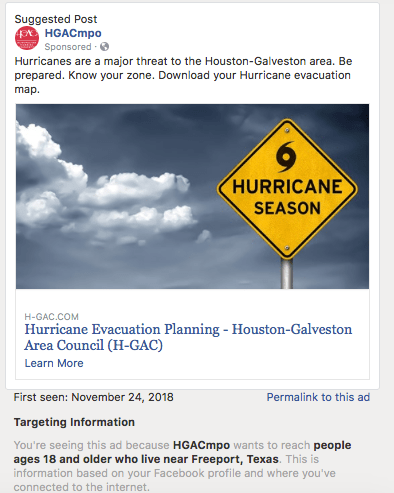
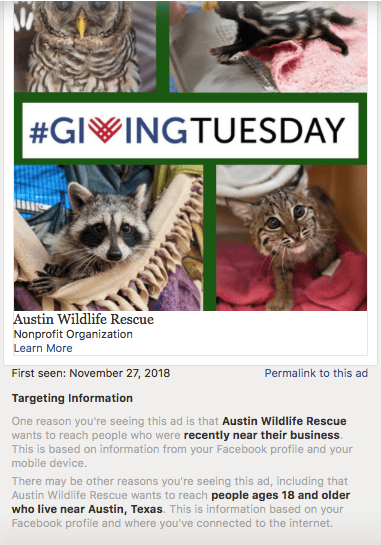
It is not initially clear why these ads were labeled “political.” Until we go back to Facebook’s criteria and review their “issues of national importance” list. “Infrastructure” is an issue. H-GAC turns out to be a metropolitan planning committee advocating for better public transportation in Houston. Which is why, it seems, that hurricane evacuation routes are considered implicitly political. It is even harder to see why Austin Wildlife Rescue would be political. The best guess I have is that “environment” is one of the terms on the list. I had interpreted “environment” as a metonymy for “climate change” but now realize that if Facebook called it “climate change” they would be conceding climate change existed (and god forbid they piss off the snowflake Evangelicals). So perhaps “environment” is broadened here to mean “wildlife?” Nothing this ambiguous was labeled on the conservative example, which means either conservatives are the ones zealous about reporting ads or identifying them because I do not see how the demographics of the tool’s user base would shape this (though I could be very wrong).
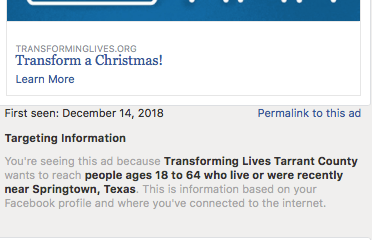
The Tarrant county ad for helping the homeless also does not appear to be partisan. Except “poverty” is also one of the items on The List. Also it can be implicitly political if you know that Tarrant County (Fort Worth) has slid from reliably Republican to a swing county,


In which case, advertisements in that county may be particularly policed. Including Christmas charity ads, apparently.
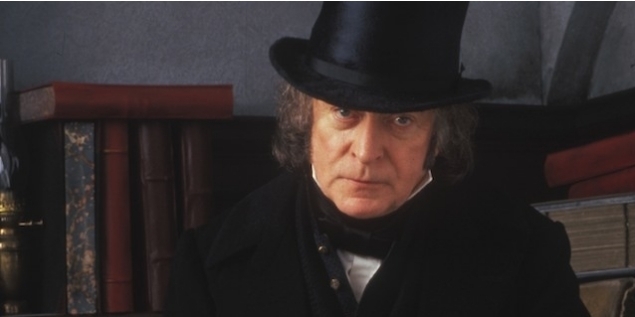
Then there were ads such as these two, which did mention parties or candidates, but do unsubtly aim at an ideologically liberal affiliation:
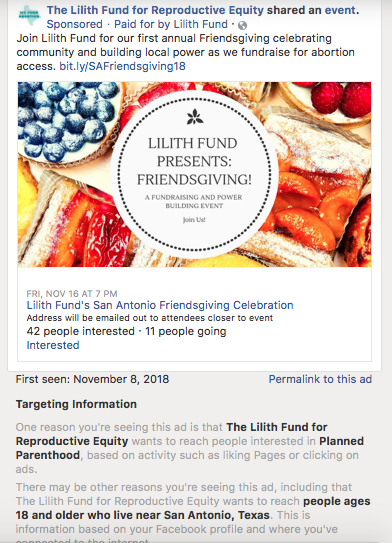
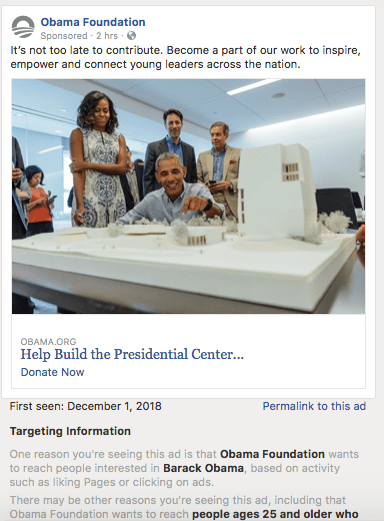
Yet one can argue Facebook also overstepped by naming these ads “political” depending on whether we see the Lillith Foundation ad as explicitly about abortion for its link to Planned Parenthood, though the ad is about celebrating Thanksgiving and meeting like-minded individuals in San Antonio (which is arguably political in the loosest sense of the word because it is important for liberals and leftists in states like Texas to meet one another). The Obama Center does not explicitly endorse Barack Obama but it does mention a former president. I also had several ads respectfully mentioning George Bush Sr.’s “service to Texas and his country (paraphrasing).
(Oh btw fuck George Bush Sr. Did this ad just show up to everyone in Texas? God this state is so extra).
Oh, and speaking of How The Fuck Did I End Up in This Targeted Audience, the one really explicitly hard right ad I got was this little gem:

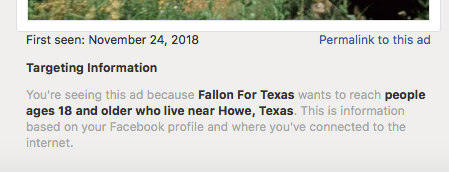
Well, it’s not the weirdest ad I’ve ever gotten.

Not going to lie, even though it was probably a data-mining front, I kinda wish I had taken that quiz.
Last but not least, this was my greeting:
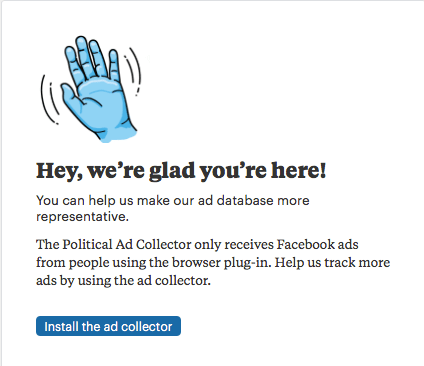
Sheesh. Talk about a comparatively lukewarm greeting compared to the one I got shadowblogging as a hypothetical conservative relative.

This kinda confirms my suspicion that the database as a whole probably contains more examples of ads aimed at non-conservatives, because that is who reads ProPublica (including independents and libertarians as well as liberals and leftists). The idea of conservative voices holding more value in non-conservative spaces does tie back to strategic elevation; however, it makes more sense in the context of building a database, where diversifying voices = gathering a more comprehensive data set.
Conclusions
To go back to the question with which we started: what unscientific conclusions might we get from dicking around on the tool pretending to be other people just for the lols?
Something more depressing than that irreverent starting point. I wrote in my first filter bubble essay, on the ideological uniformity and hyper-partisanship of right-wing media (see the “Visualizing the Echo”) section and already mentioned that target audiences are usually divided between far right conservative and “everybody else.” Putting these ads in context with the research I cited in that post, it seems that Facebook advertisements in this media ecology niche work in a similar way.
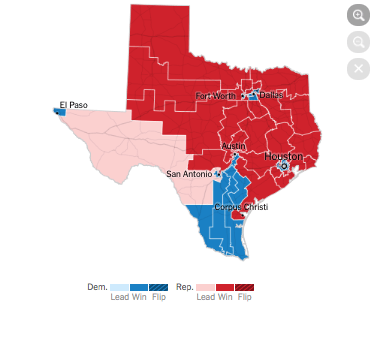
Perhaps the most striking revelation was that when masquerading as a 78-year-old Georgian each ad reached out explicitly to the “very conservative” audience while, when using my real demographics, I was less likely to be explicitly named as a target due to political affiliation (outside of midterm ads) but was implicitly coded as liberal in the Targeting Information by my age and the tendency to guess that I live a city as urban Texas tends to be liberal and the suburbs are increasingly counted as swing counties.
I hypothesize that for liberals, the intensity of political ads for candidates and partisan issues seem die down after election season while far-right advertisements targets their audience all the time. I’d be interested in studies of wider trends on this topic. I would love for this hypothesis to be proven wrong.
There are also waaaay more factors to consider here including spending, positioning, and circulation. A few general caveats about this post:
- I have this post queued to publish long after I initially did this exercise earlier than I scheduled this post. This is why I talk at length about the midterms later, because the pre-midterm ads were still fairly recent.
- If I had actually sat down and thought through this experiment more carefully I might have considered making political affiliation the only variable in this test. In other words, I might have run an experiment of two people in Texas (gender not specified) the exact same age but with different political affiliations and then added more variables. But in the end I am self-centered and we almost hit 2000 words anyway so.
- I also happen to be from a swing state originally and I live in a potential future swing state (that are both mistakenly identified as solid red states by outsiders) where the demographics and affiliations of individuals does not match the voter records due to gerrymandering, voter suppression, and other factors. It might be interesting to look at more solidly Democratic or Republican battle grounds.
As you see, there are so many ways that future “experiments” can go and mine can be amended. But for now, I’ll leave those up to you!
Read More:
Texas State Ethics Commission. Political Advertising: What You Need to Know.
From Electionland’s “Why Am I Seeing This? Interesting Facebook Ads From Our Political Ad Collector.”
- What Facebook Political Ad Algorithms Don’t Catch
- This Member of Congress Spends Big on Facebook Ads
- Uber Targets Ad at Supporters of Black Lives Matter
- The Biggest Political Advertiser You Probably Haven’t Heard Of: Marsy’s Law
- Supreme Court Battlefield: North Dakota
- Cordray Campaign’s Made-Up News Pages Now Have Disclosure
Works Cited
Anonymous. “Sorry to Burst Your Bubble 1/3.” Tech Theory, Published: December 16, 2018. Accessed: December 19, 2018. https://techtheoryblog.com/2018/12/16/sorry-to-burst-your-bubble-1-3/
 PoliTech
2 comments