
 Posted by
 But is that its “fault?”
Some weeks ago, I went over three tools for researching archived political ads on Facebook. Sometime after that, I used one of these tools for a little “experiment.” (And by experiment” I mean dicking around for the lols but in a way that yielded the seeds of a potential hypothesis that could be proven wrong in a way that is productively wrong. Which is essentially the core of research).
This time, we’re going back to the basics. And by basics, I mean unstructured hell that is the Facebook Ad Archive. This time we’re going to do some digging into credibility and potential rhetorical efficacy of advertisements. The questions of what the advertiser intended and how the information can be weaponized and distorted out of context in ways that do not require much manipulation of the message itself will appear sporadically. But ultimately even insight into sources do not tell us much about intended audience or effect which, as it turns out, might actually be produce an insightful revelation anyway.
Around the time I drafted what would turn out to be the Three Tools post, I played performed the following “experiment” and took most of the screenshots (though I repeated it multiple times to see if there were any new discoveries that would impact the point of this post). Nothing substantial about the goal of this post changed in doing the experiment, though I became aware of at least one very small, but still important detail I initially missed when editing the post and will cover that detail when I come to it.
Back to Beto
I chose “Beto” as my keyword because at the time of the experiment, the nickname of El Paso congressman and former Texas senatorial candidate Beto O’Rourke was trending, as rumors of a potential presidential run were in full swing. You can review the Facebook Ad Archive if necessary (which is probably won’t be) and/or Facebook’s criteria for what counts as a “political” ad (which I suggest doing) in the first two sections here.
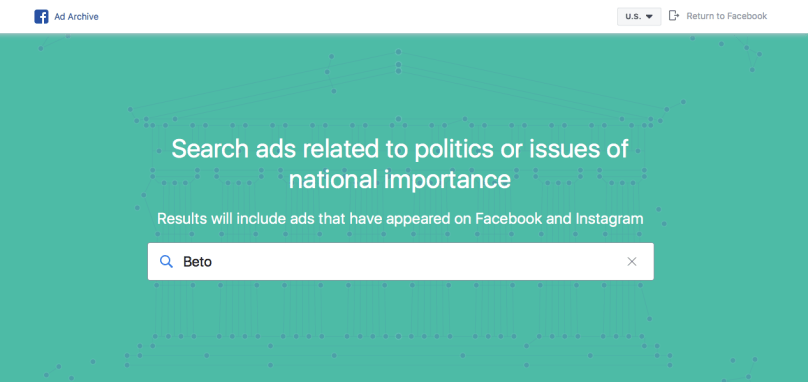
I am just going to jump right in. First, let’s limit the “Type of Ad” to “Political and Issue.” I kept the filters open for all statuses and all pages. I unthinkingly left the country filter on the U.S. by default.
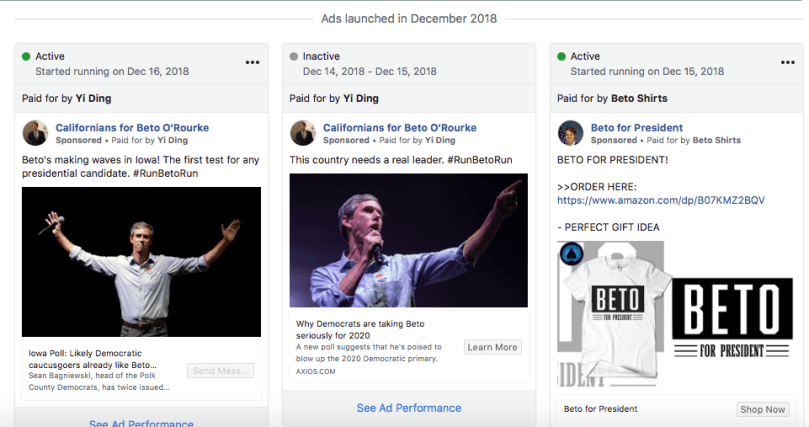
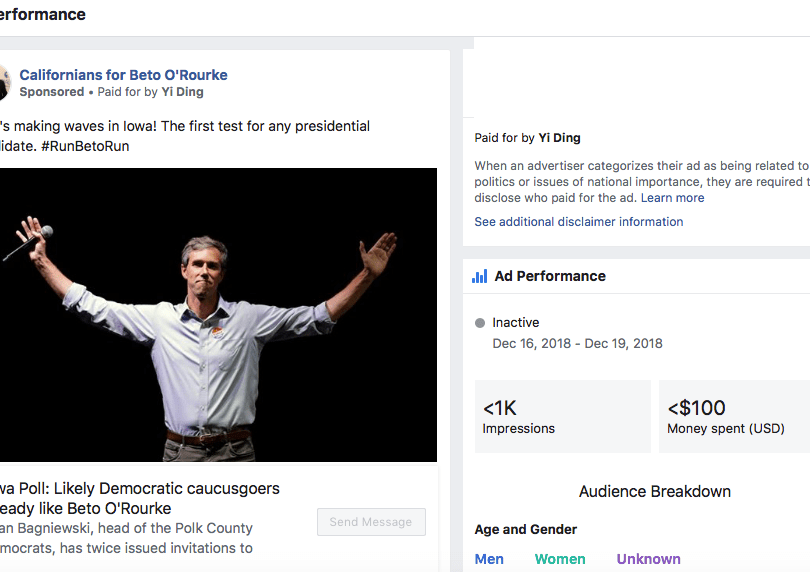
The first two ads on the result page are sponsored by a FB page called “Californians for Beto.” The aforementioned detail I did not notice until editing this blog post is the “paid for by Yi Ding” credit above both Californians for Beto O’Rourke. Even though I noticed this after I wrote the next few paragraphs, I do not retract anything that follows.
The third most prominent ad is a knock-off of the Beto shirt that is obviously not affiliated with his campaign — as of writing, he has not even announced his 2020 plans. Many, if not most, of the ads on the page are for knock-off merchandise. Usually shirts, hoodies, a few baseball caps.
And this

I admit the “Californians for Beto” thing struck me as suspicious. “Californians for Beto O’Rourke” just sounds like something that a conservative would say in order to turn proudly Texan independent voters off from O’Rourke (even though more native Texans voted for O’Rourke than over Cruz, and O’Rourke, unlike Cruz, is actually from here. Also Californians who move to Texas are often conservative while Texas as a whole is a very polarized state). Perhaps I am being paranoid, but Calexit taught me that smart people will fall for something that may seem to be obviously fake (hell Rachel Maddow fell for it. And so did I and so did most y’all — not many people immediately realized it was a Russian psyop until later) and even after knowing its fake it can still have its intended effect (I knew it was supposed to stir up infighting amongst liberal Americans and I still got mad as hell at fucking hypocritical Californians).
So, checked out the group on Facebook. Look how few followers they have.
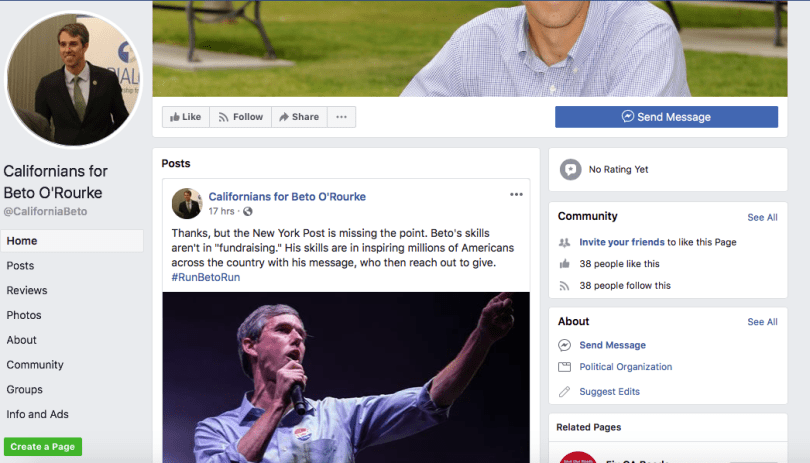

I dunno man, maybe there are 38 Californians super passionate about Beto. I don’t doubt he’s popular outside Texas. That said, just to be sure, I did a little investigating. Each of their posts (which were all cross-posted from news outside by the mod) had roughly about 4 likes. I clicked on the profile of each person who liked one post. Just in case they are real people, I am not using names or pictures. All of them had VERY high privacy settings. Two people appeared to have no friends. Another user’s timeline was the same two pictures post over and over again at intervals (a profile pic change, but still!). I guess you can hide your friends on Facebook now but it was still odd. Yi Ding seems to be a real person with over 600 friends and several pictures of his family. But no guarantees about the others. My guess is more likely puppet accounts than bots.

Ads like this
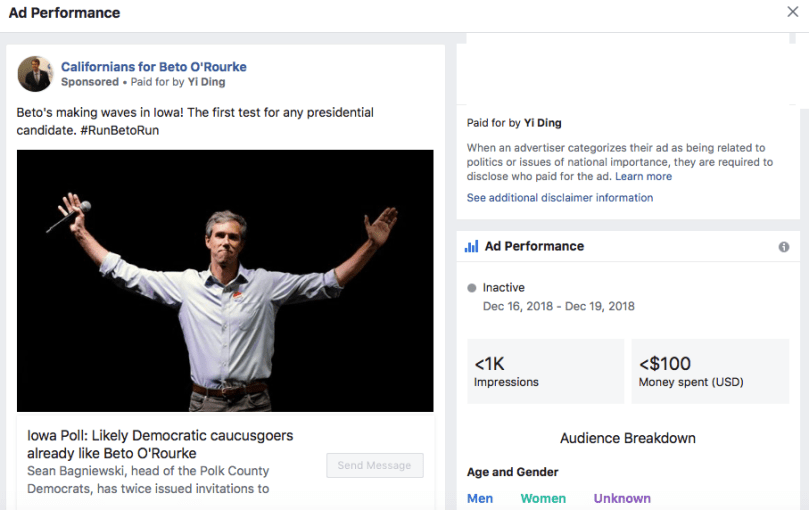
Do not qualify as misinformation — it is true that O’Rourke is popular outside Texas and as long as the source is legit, they are in the pink. That said, it should not be taken at face value. Look, it’s more likely that I am getting paranoid researching computational propaganda, I am not saying it’s Russian propaganda like Calexit, or that I am 100% sure that it is a deliberate misinformation tactic to rile up Texas independents who voted for O’Rourke, or considered it in the 2018 midterms. In fact, it seems the audience has been entirely in California
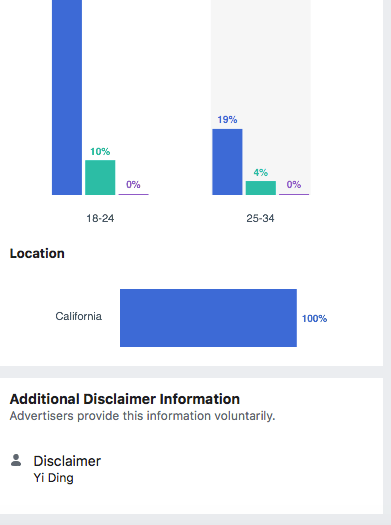
But it also has less than 1000 impressions. And as I wrote early on the Internet Research Agency Archive, usually for this kind of thing, people create a lot of duds before they find that one bit of constructed information that goes viral. Was it one of the many ads we see on the IRA Archive that had 0 impressions that turned out to be a branch of one series of IRA advertisements in a database with hundreds of them?
Or maybe Yi Ding is a Californian really enthusiastic about Beto O’Rourke and wants other Californians to like his Facebook page. Even if the members turn out to be puppets, it is not out of question that puppets could be created to artificially boost the popularity of a sincerely written page. and I’m just hyper-paranoid. The “paid for by Yi Ding” note I barely noticed before also clarifies that Californians for Beto may be a page you can like on Facebook, but it is not a “real” organization. However, if I didn’t dig up that Facebook page and investigate its members, I may not have noticed.
And that’s the point. Credibility and misinformation is not always obvious when intended audience is not always obvious. The intended audience is still not obvious, which means if it is intentional propaganda it is very good and I can see the potential for pages like this to be weaponized should O’Rourke run against Corbyn (the Other Texas senator. He’s as bad as Cruz but less nationally famous for being creepy). This does not mean that page shouldn’t exist. It only means that I have no way to evaluate it based on probing credibility by examining source.
Maybe the real point is the non-verification we found along the way. Or, rather, that verification does not entirely help with understanding how these ads ultimately “work” rhetorically. It can also be too easy to want to base verification on the source. There is a fine line between wanting information to come from credible places and dismissing credibility outright based on perceived ideological orientation of a source. Sure the Facebook Ad Archive is frustrating in that requires some effort on the part of the viewer that most people — including me — just don’t have time to take. But maybe the point of all this was to underscore veracity and authenticity is not as easy to gauge as we like to think.
The Facebook Ad Archive offers transparency into what ads Facebook labels as political issues or “news.” It does not offer much transparency into misinformation and requiring that advertisers submit a disclaimer at the bottom of each ad does not necessarily help. That said, to be fair, this level of context is impossible to algorithmically generate — think of Facebook’s previous flagging issues and Tumblr’s trigger happy puritanical bots. For right now, this is where research in rhetorical analysis, social sciences, digital humanities, and political science (which is not a science but no less important for it) is necessary: though these are, perhaps unfairly, considered more “ambiguous” techne when your object is so ambiguously defined, then it is worth examining the places where hard lines between “news” and “ads,” or “truth value” and “truth value by identity” are drawn. The Facebook Ad Archive, though a hot mess, is not a bad place to start.
 PoliTech
2 comments