

 Posted by
 Note: this post was originally put in a draft in 2019. I am publishing it now, incomplete and unedited, five years later to make public the information I gathered when the site was live for the purpose of archiving it.
Background:
UnfilteredNews was created by CJ Adams of Jigsaw and Izzie Zahorian , a self-described “researcher, designer, and strategist” who works for Google’s Research & Machine Intelligence. Inspired by the dedication of Myanmer journalists who risked death under military rule in order to keep up with current international news, Adams and Zahorian wanted to create a way to combat complacency in news (non)consumption, especially in the United States.
“Even with the power of the internet, it can be surprisingly difficult to explore the diversity of global perspectives. Technology has made it easier for everyone share information, but it hasn’t made us better at finding viewpoints that are distant from our own (“If you are reading this, we are probably in the same news bubble”)”
The duo launched the beta project of UnfilteredNews in March 2016. The software works using Google News to gather data on headlines from all over the world. It then visualizes each country on a non-scaled map that shows which topics were trending in a specific country on a specific news day. Their archive spans from March 7 to September 1, 2018.
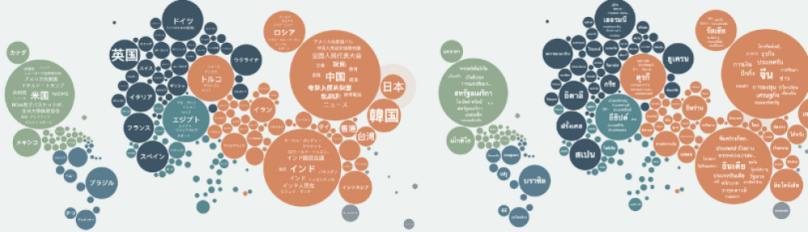
The Basics
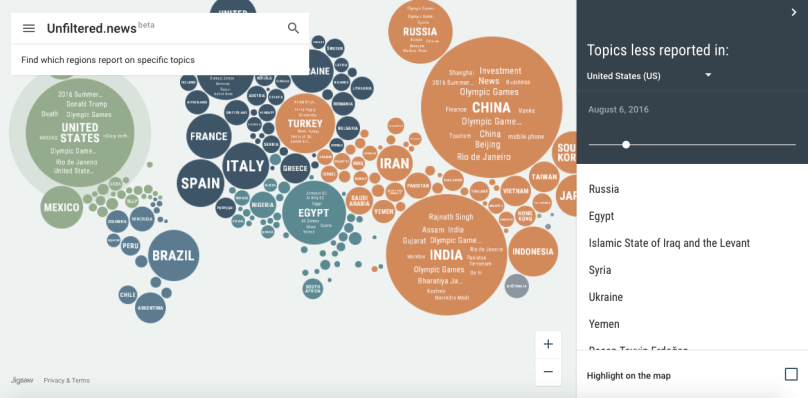
Look at the navy header block on the right hand bar. Notice the white line with the ball cursor. That line is the timeline. Move the ball back and forth on the line to establish a date. Once you have searched a topic, the line will represent peaks and dips in popularity of a topic on that date.
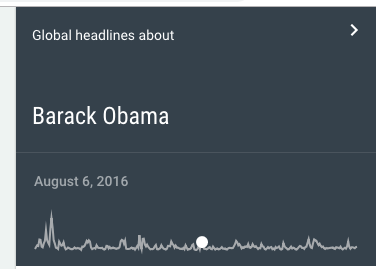
Searching Popularity
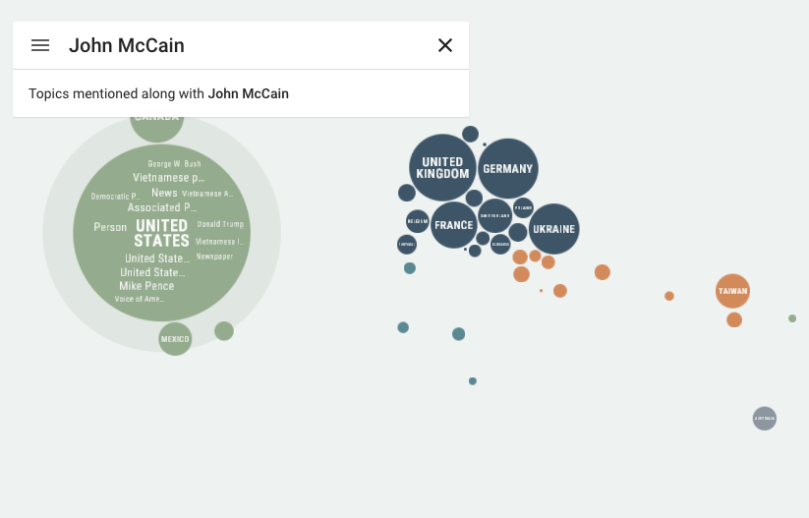
There are several ways to search for a term’s popularity. The most obvious is to use the upper-left hand search bar to show the relevance of your topic in any country on any date, in addition to showing other topics of interest in that any country’s press on that date. I cannot demonstrate it with this static image, but if you hover your cursor over “Topics mentioned along with [Topic]” below the search bar, predictive text will appear showing common shared search terms.
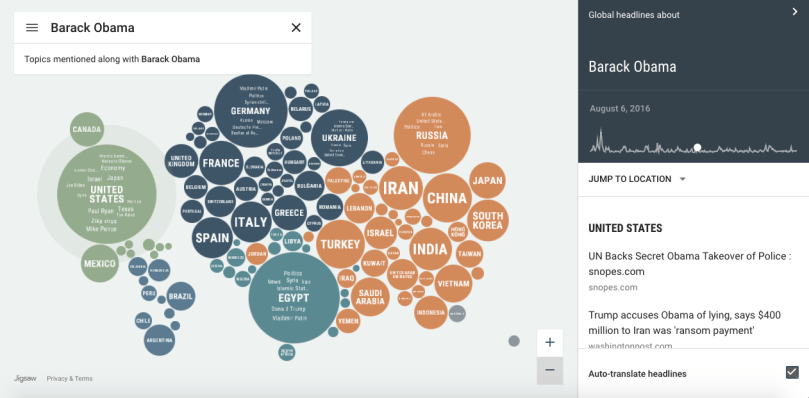
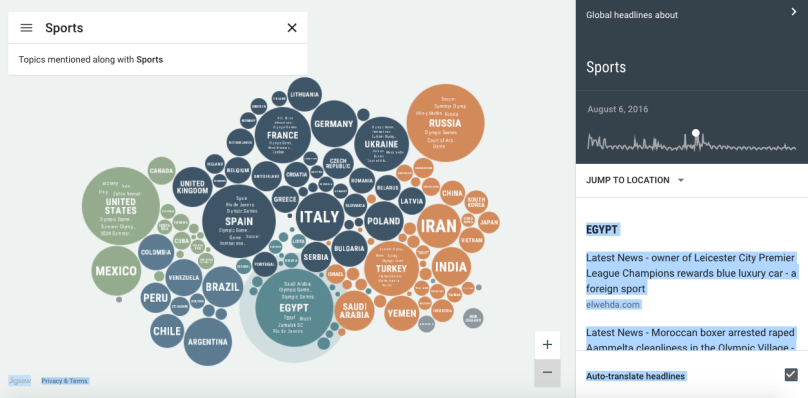
If you want to search by nation, simply search for a topic and click on/zoom in on your country or region. Or choose a date and click on/zoom in on your region or nation.
Another way to compare
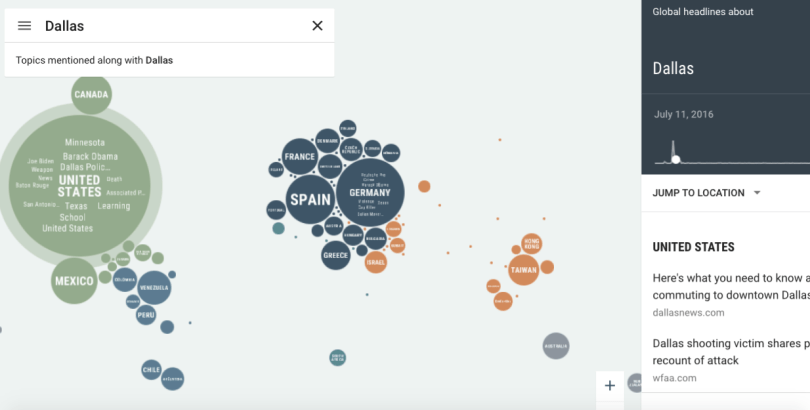

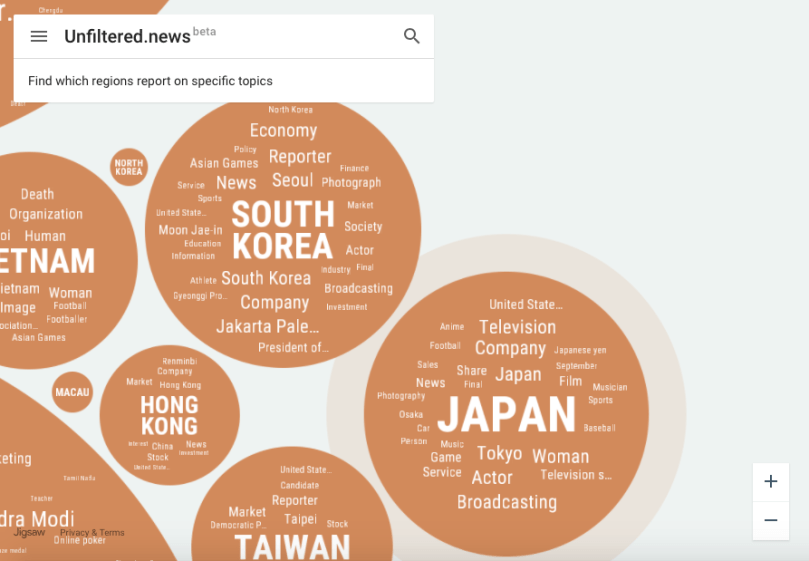
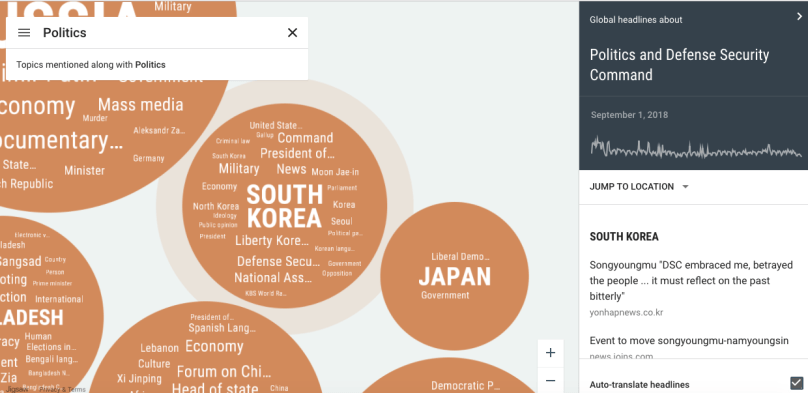
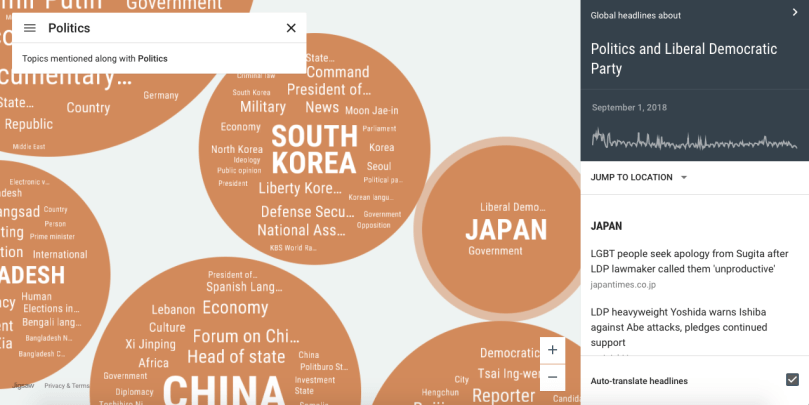
To search popularity within a given nation or region, simply select a circle and/or zoom in on a region on the map. If I click on the Japan circle, the website narrows in on popular news topics in Japan. You can see the Japan circle is highlighted after I click on it.

However, if I wanted to compare geographically close countries, I can also zoom in/out to, for example, compare Japan and South Korea’s daily headlines side by side.
Finally, to perform a more complex search, you can filter by
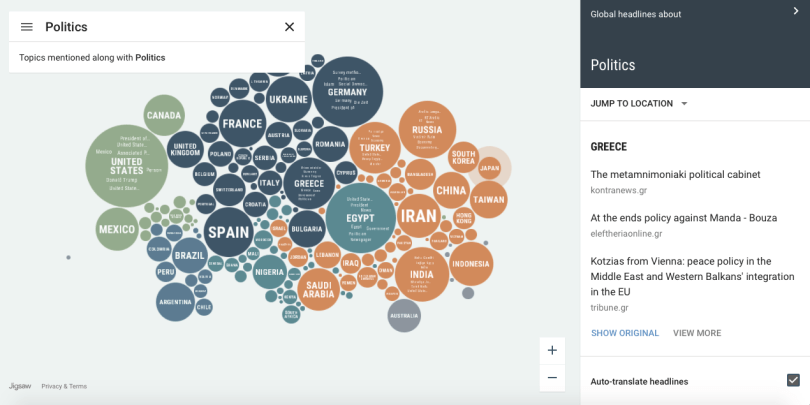
To go back to Japan and South Korea,
Searching By Least Popular
To see what countries
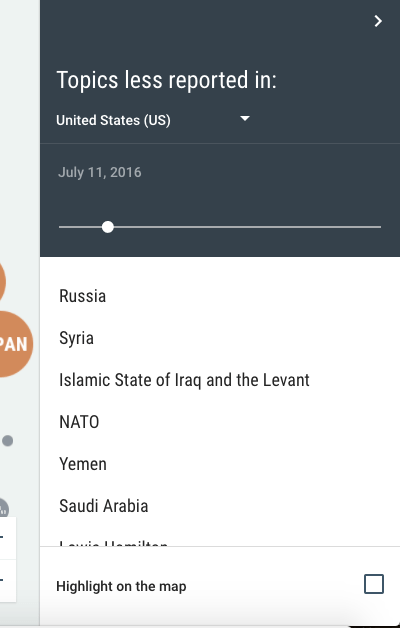
Select one of these topics and see
NOTE:
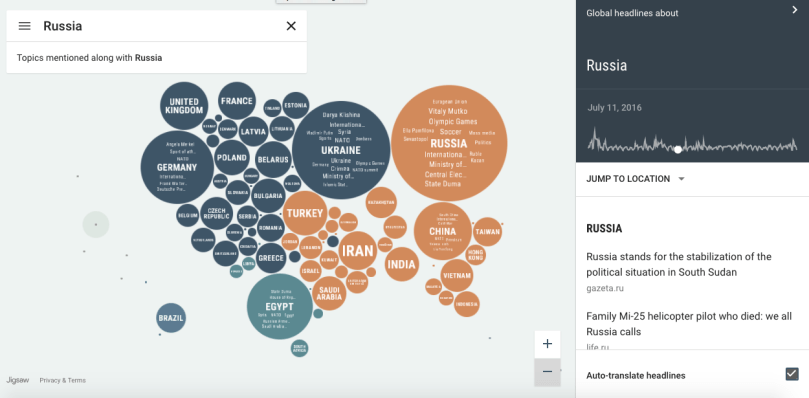
Two final notes. First,

However, to go back to Japan on September 1, 2018, the japantimes.co.jp piece does not have an active link.
Second,


Conclusion
I begin by stating that this project is in beta. There are many limitations, including that the timeline ____ or Anglophone centrism that I am sure shall be further refined. As someone familiar with the sheer amount of effort it takes to create a project like this, it is clear to me they have worked on this for years so while it may seem sketchy to some people I am deeply impressed. Thus
This project is unique amongst the several tools I have practiced thus far for this mini-series in that it defines “the bubble” on nationality instead of ____.
That said, while the project is incomplete, I am curious as to how Google Data ____. For example, check out the top topics in the United States and Japan within politics — both of which happen to involve each nations’ conservative, increasingly far-right ruling parties.
____
______
Does it change you opinion of the sources if you know that The Japan Times is a highly respected Japanese news paper while Salon is, well, no offense, but it’s Salon. Or that (as far as I can tell) the top headline in Japan on that day may have been “Osaka High Court orders government, 10 firms to pay ¥302 million in damages over asbestos exposure” (which is no less inherently political than than LGBT groups asking the government for an apology, surely?). This taps less into philosophical questions of what constitutes politics and more into the perhaps no less philosophical questions of what subjects are algorithmically linked to “politics” — note “television,” “broadcasting,” and “woman”* (or “women;” Japanese does not necessarily have plurals) appear in _____ but the algorithm does not recognize these as political subjects even though censorship and feminism are culturally relevant topics there, as anywhere else in “The West.”
Of course it goes without saying there are cultural translations that Google Translate cannot master and much context is needed. I know a bit about Japanese politics as one of my many eclectic, amateurish interests, and so chose it as an example without even thinking about it because I do intermittently read The Japan Times and have a bit of context. I ended up Googling most of the South Korean papers and terms but frankly, most people are not going to do that. In fact, if your goal is to learn about ___ it is probably not worth your time and energy (I definitely learned new things about South Korean press though!).
Which brings us my main point, that the strength of UnfilteredNews’ model is also its failing: emphasis on the macro___ reading. On the one hand, the ____. On the other, the level of _____.
Perhaps the website could benefit from a good filtering algorithm.
 PoliTech