 Posted by
 FlipFeed
Note: this post was originally put in a draft in 2019. I am publishing it now, incomplete and unedited, five years later to make public the information I gathered when the site was live for the purpose of archiving it.
Background:
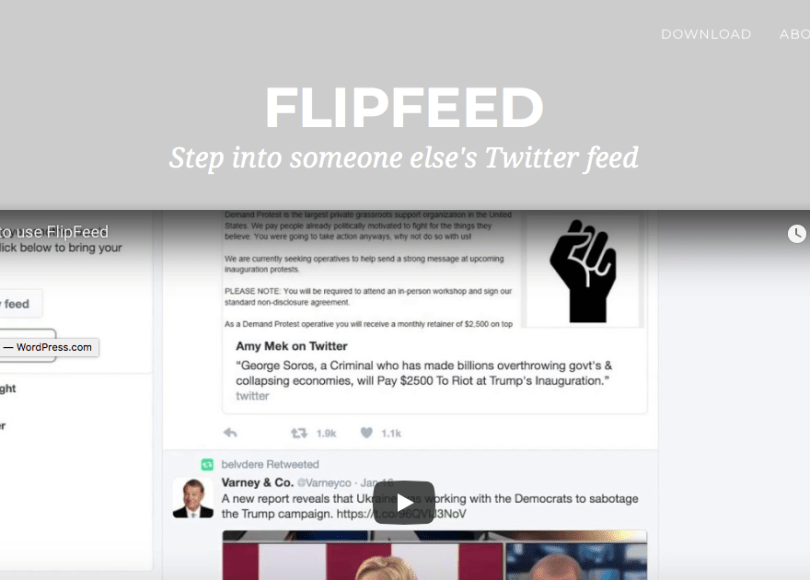
FlipFeed is a Google Chrome extension created by researchers for Laboratory for Social Machines at the MIT Media Lab “to explore how social media platforms can be used to mitigate, rather than exacerbate, affective polarization by helping people explore and empathize with different perspectives [x].” The extension allows Twitter users partial access to the feed of another real-life, human Twitter user. In other words, you can temporarily “scroll” through another Twitter user’s feed to get a sense of what kind of news stories appear on Twitter for another person. The anonymous donor users are selected by “inferred” political affiliation as determined by “deep learning and social network analysis.” The purpose of the extension was to make Twitter users aware of their Twitter feed filter bubbles and, apparently, cultivate empathy for the political Other by dwelling within their feed as a rhetorical space.
Overview:
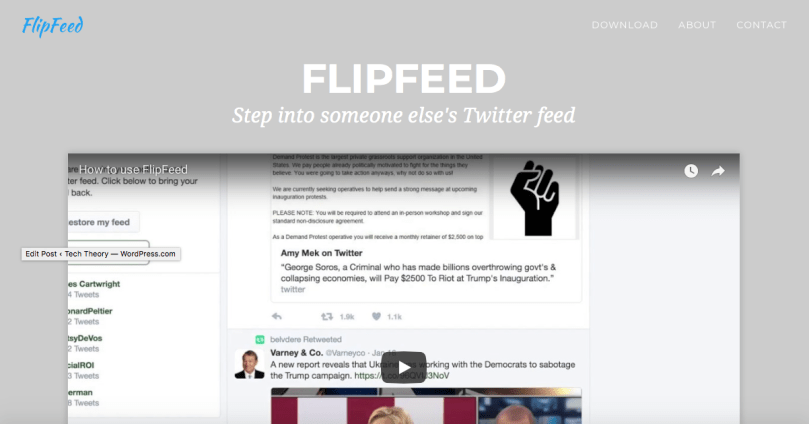
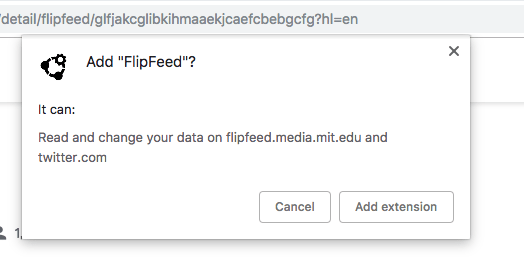
To get started, just click the bright blue, large Get Started button at the bottom of the demo screen on the main project webpage to go to the installment page of Google Chrome. FlipFeed is incompatible with other browsers.
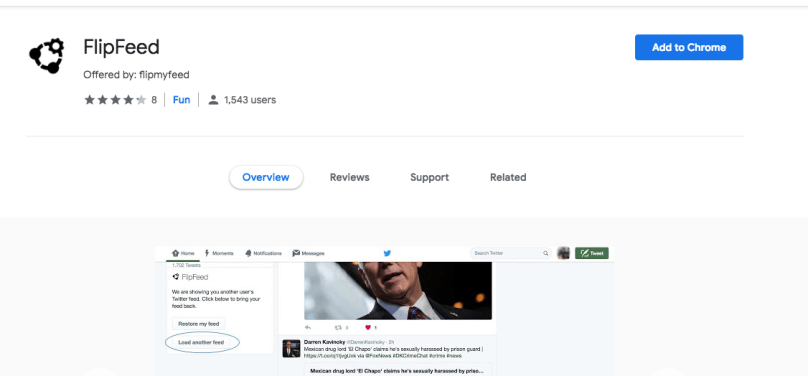
You have to accept these terms and conditions and grant MIT researchers access to your data.
After adding the extension to Google Chrome, log into your Twitter account. There will be a small box under your profile
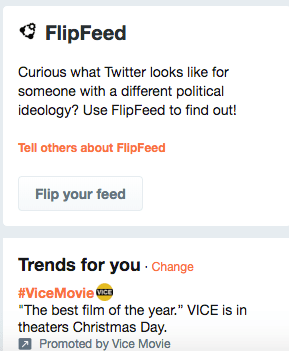 \
\
Then your new feed will load.
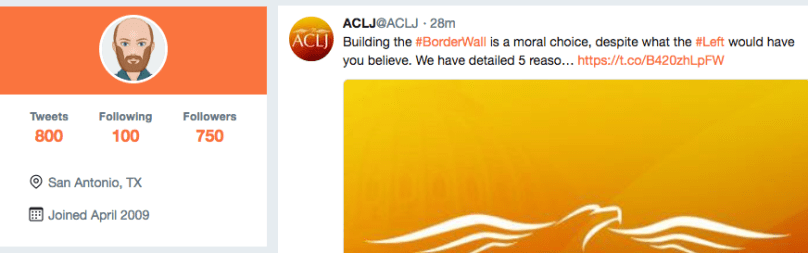
From here you can scroll the feeds down a certain point in the person’s history.
Note: that while your Twitter feed changes that your Who to Follow side bar still suggests accounts to follow for you, and not the person anonymous person whose feed you are browsing. If you leave the page within Twitter, you leave the app. In other words, if you click on one of your suggested friends, you leave the app and have to go back to “Flip Your Feed” on your home feed to start over again. I suggest clicking on hyperlinks in Tweets on the other person’s feed to open them in a new tab (outside the FlipFeed interface) if you want to read them.
This is the first person to which I was matched:
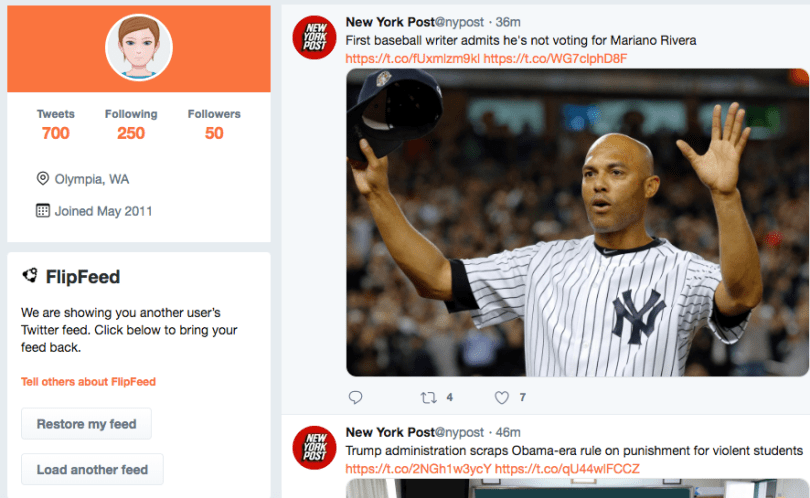
This user’s feed was literally — not figuratively — entirely dominated by football and The New York Post. For the record, since I have seen some NYP stories non-ironically reblogged by otherwise news-savvy people on my social media feed, The New York Post publishes stories like this:

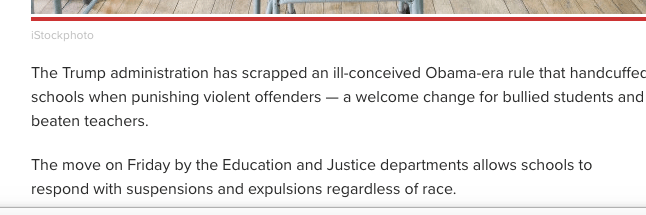
But also this:
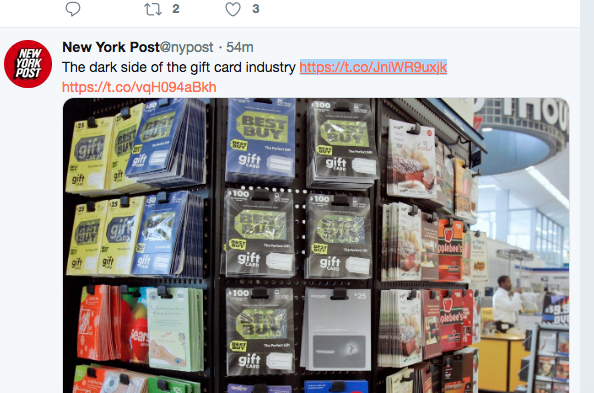
The most relevant insight this woman’s feed offered, to me, was that I saw a different way of using Twitter as a social medium than I usually see — specifically, strategically using Twitter only to follow a few subjects. Guessing by her low follower account, she may not be using Twitter as a social medium to connect as much as explicitly as a news feed and/or personal archive. What’s the relevance of this insight, politically? Nah, not really anything besides me being a nosy snoop.
The second person had a more diverse feed; not in the sense of politically diverse, but more diverse in the sense of following more people and having somewhat more diverse interests.


Basically he loves guns and Trump, especially guns. Mostly, he retweeted pictures of semi-automatics, but he also likes antique guns like the one in the picture). He also has more than a slight populist bent (see Rick Swift tweet), which offers a bit more context by hinting at why he believes what he believes whereas other flipped feeds I saw had statements but no hint at justification (the coherency of this justification is not the point here).
When you want to exit the feed, go back to the gray box under your sidebar profile.
I am intrigued by the few Black Guns Matter retweets.
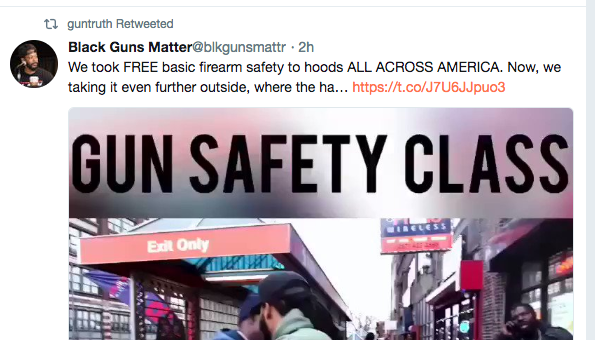
Why retweet a Gun Safety Class ad? Was it for the benefit of any Black followers he might have who may also be gun enthusiasts? If so, why not an ad for a class in San Antonio or any other city he has roots, instead of one for hoods ALL ACROSS AMERICA that links only to one of their videos on YouTube and gives no location for these classes more detailed than “Shouts to #NorthPhilly.”

This information cannot be found in the original re-tweet. I had to track down the ad on Black Guns Matter’s Facebook group. Did San Antonio Man actually read the ad, or did he retweet it without reading because He is Not Racist He Has Black Fri….Acquaintances From Gun Club (whole lotta in-group/out-group identifications going on there). Or is there something more ideologically nuanced that FlipFeed does not provide context for?
Full disclosure: I do not actually care what San Antonio man truly thinks about race. I went over the Black Guns Matter as a case study for rhetorical analysis on how a single piece of information can signify multiple things depending on its appearance in a specific context (something I already discussed with Californians for Beto). I’ll come back to this.
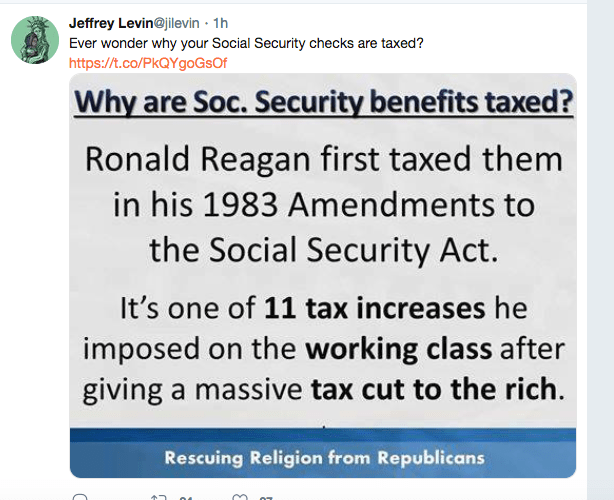
As I went through several flipped feeds, I became curious as to whether or not FlipFeed’s algorithmically calculated “matching” with “other view points” only took ideology into account. Is this a learning algorithm? Does it track whether or not you spend more time on other people’s news feeds with more diverse content (diverse in terms of blogging about more than one thing — like San Antonio Man) over those who retweet the same one or two subjects (see the woman in Olympia).
Review:
I am going to start with how well this extension contributed to its stated purpose. I have nothing to say about design and usability because it is literally just Twitter. It imitation of a real Twitter feed is spot-on. It says something I did not immediately figure out which part of the feed was mine or Flipped as they were so smoothly integrated.
MIT is probably getting some great data out of this. I support the work of the Social Machine Lab because integrating cultural studies with mixed digital methods is the exact kind of research I do, love, and in fact created the blog for. I volunteered to give my own feed to the project because while I don’t trust Google a nosehair’s breadth I do support MIT’s Social Machine Lab and I am happy to provide data for the project since Google already owns my soul anyway. This tells you a bit about my feelings regarding the overall value of MIT’s experiment.
But does FlipFeed bring us to empathy for people with different viewpoints?
Writing now in 2022:
Empirically speaking, no.
MIT’s Ethan Zuckerberg admitted his own own three attempts at digital tools — Gogo, Social Mirror, and FlipFeed — were not only unsuccessful, but Social Mirror in particular caused participates to emerge more annoyed and less likely to engage someone from the other side (Zuckerberg interview by Piore Technologists are Trying to Fix the Bubble They Helped Create).
More accurately, but no more flattering, I felt like I was browsing through the library reading the abstracts of different mildly interesting academic articles. I not only do not care about their opinions, but depending on the audience, I am not sure that we should. Wouldn’t white liberals maybe be better off listening to the many different perspectives of people of color with whom they share basic goals rather than ideologically “opposite?” Should we even be engaging the possibility of empathy for Nazis? By “we,” I do really mean my fellow white people and me because the problem with breaking filter bubbles on the base of ideology without factoring into nationality and especially race (the most easy things for Twitter to document) is that it splits ____ into neatly partisan divides, focusing the attention of the “everybody else” into the more densely “red” sectors of the bubble.
I certainly learned things from FlippedFeed. I learned who several of the most popular gun accounts on Twitter are, and made notes in case anyone I know is studying rhetoric of 2nd Amendment defenders and nationalism or something and whatever. I also learned a bit about self-reflection: did you catch that moment in the Overview where I started probing the man’s background to wonder if we had anything in common or where he might fall into my experience with conservatives? that I might use to better contextualize his Twitter feed as a cultural artifact? I didn’t notice. Until I edited this blog post.
The problem with training empathy is that the “quality of empathy” such a specific thing that is so based on an individual personality interwoven with the structures that produce moral education that cultivation of virtues and ethics is something that I have come to believe that humans have to take the lead in. As a post humanist — really an extrahumanist — I was surprised to come to that conclusion too!
I am highly skeptical that FlipFeed can be used to foster empathy for reasons mostly related to Exposure Theory and “belonging” as well as the idea encountering information =/= empathy with the rhetor. I am not in a position to know whether or not the tool can serve as a practice in metacognition; however, it may have more potential in that regard. One would have to see the broader trends and in fact that may also be a potential academic project for MIT or other institutions with access to this data.
I did find myself thinking that should I ever teach a digital literacy heavy course, that FlipFeed might be a fun in-class activity on the first or second day to briefly introduce students to the concept of personalization. It is also an artifact that I found interesting not as a tool for analysis but as a potential object of analysis for some of the reasons I hinted at above wondering if learning algorithms were involved. You may notice this has been both a more personal and more academic review that the last one. This is because more than any other tool, this one turned on Academia Brain or Teacher Brain.
Still maybe it’s fitting a project that uses personalization as a way to attune us to personalization should be difficult to review without getting personal. So while I can’t fully recommend it as a “bubble bursting” tool, it is a well-designed project with a more philosophically nuanced goal, and I would certainly welcome other personal perspectives if anyone reading this has used or will use it!
 PoliTech